Mayor's Message – 6 August 2026
Published on 03 August 2026
How about all this winter rain!
I have heard some cereals croppers from northern Victoria and the Riverina say this is the best winter season they remember. And yet, it is said that we are entering a strong El Niño, where we would typically expect below-average rainfall. So, despite recording well above average rainfall totals for recent months, the longer-term forecast is for below average rains for spring and summer, and probably a long fire season. We’ll see.
I drove back from Maryborough the other week and noticed that Cairn Curran is starting to refill after getting desperately low. Joyces Creek was still a creek, but from the Pyrenees Highway crossing we can see the waters advancing south. This is good news for all of us who use Cairn Curran for recreation and sports; even better for our brothers and sisters downstream in the Shire of Loddon, for whom Cairn Curran is an essential source of water. (Most of us in Mount Alexander Shire get our water from the Coliban catchment and reservoirs around Kyneton and Malmsbury.)
Recently at Council, we heard from a local landscape ecologist about some Central Victorian initiatives to help restore ecosystem health by building better soils and by improving the ability of our woodlands to absorb more of the rain that falls.
This is a special challenge for those of us that live on upside-down country. Upside-down country is a term used to describe the goldfields of Central Victoria, where past deforestation and intensive mining activity have seen the topsoil washed away, leaving the clay layer as the top horizon of soil. One of the main problems with this is that the clay, baked hard under our summer sun, becomes impervious to water. I recall that during the floods of 2011 and 2022, when despite over one-hundred millilitres of rain falling in 24 hours, when I dug my thumb into the soil on a Barkers Creek hillside it was dry as a bone and only half an inch deep! This was because that hard clay just would not absorb water.
The topsoils that once overlay the clay served to absorb much of the rain, providing a good medium for grasses and shrubs to grow. This permeability of the topsoils also helped to slow down the runoff into creeks and rivers, thereby reducing the speed and intensity of floods. Instead, the flood waters continue to erode deeper and deeper the gully creeks, lowering the water table and gathering silt to pollute the otherwise cleaner waters in Barkers Creek itself, which in turn floods Campbells Creek and then the Loddon with silt-rich runoff. Clay-silt runoff is one of the main pollutants now in our waterways, and it bedevils the work of farmers and conservationists alike who rely on clean water.
How do we restore these lands so that they can absorb more of the rain that falls, and how do we enable the building of topsoils to once again clothe the clay? There are practical measures landowners can take.
Firstly, we can make contour banks with earthworks and/or by laying fallen branches along contours so as to slow runoff and hinder erosion.
Secondly, we can plant more native grasses and ground cover plants – they will also help to trap detritus as it washes down the hills.
Thirdly, we can thin the regrowth canopy of trees to allow more sunlight in which in turn allows more of the ground flora to thrive (returning the closed forests to more of an open woodland).
Fourthly, we can build little weirs across our smaller, upper-catchment creeks, so that instead of waters rushing downstream and eroding further the gullies, the waters can form chains of ponds and then seep into the ground.
Over time these eroded creeks can start to level out, raising the water table and thus making available more water and nutrients to the vegetation and crops we need. This is one approach to restoring the forested lands in our upper catchments, and you can see this work at the Spring Plains Biolinks site near Heathcote.
Restoring the natural functions of these lands and waters is one important way we can repair our landscapes, mitigate against downstream flooding and rehydrate and rebuild our soils to provide more productive agricultural land and healthier environments. Another approach to help build better soils is through regenerative agriculture.
Here at Council, we are proud to partner with Healthy Landscapes to support our farmers with practical land management courses. Healthy landscapes have run several courses in neighbouring shires, and the next course is called Holistic Grazing Management. Land managers are invited to come along and learn more about pasture health and grazing livestock. This course commences in August and runs until May. There are face-to-face sessions spread over this time, and it costs $150 for the course, see more details here.
Building better soils is one crucial way that we can improve the productivity of our agricultural lands and also support more resilience and biodiversity in nature. I look forward to writing more about this in future.
Another important way to a healthier environment is through better management our own rubbish and waste. You may have heard that there is Victorian Government legislation now for local councils to better manage household waste. Fundamentally, this is about getting organic matter out of landfill. At the moment, about thirty per cent of all the general waste from Mount Alexander Shire (that’s what goes in the red-lidded rubbish bins) is kitchen and garden organic matter. If we can stop putting kitchen organics (vegetable scraps, cooked food leftovers, bones, eggshells, etc) and garden waste (lawn clippings, pruned branches, leaves, old fruit, etc) in our landfill bins, we will save hundreds of thousands of dollars per year in landfill costs, but we will also prevent huge amounts of greenhouse gases to be emitted from our landfill sites.
This is because when we let organic matter decompose above ground (in a good compost heap or windrow) it breaks down with oxygen and forms a nice humus or compost, emitting a small amount of carbon dioxide. When we put it into landfill, it rots down without oxygen (called anaerobic decomposition) and so it produces methane, which leaks out of the landfill into the atmosphere. Methane is many times worse that carbon dioxide in terms of greenhouse warming. If we can remove organics from landfill, in terms of greenhouse gas reduction, this will be equivalent to taking one-in-nine petrol cars off the shire’s roads!
This is why we’re considering various approaches to how we manage FOGO (Food Organics and Garden Organics). We are so fortunate to have so many committed and well-informed residents who compost at home or have joined community composting initiatives like YIMBY.
Whatever direction Council determines in coming months, we remain committed to supporting and working with home composters and community composters because we recognise that managing waste and recycling successfully requires a range of responses and activities.
Stay tuned to our website for updates and information on our waste management. I look forward to writing more about this and other aspects of how we live on and manage these beautiful lands that make up Mount Alexander Shire.
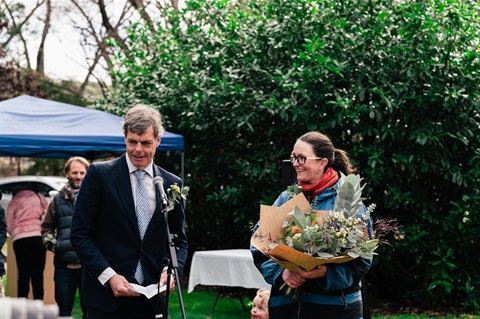
Image: Mayor Toby Heydon and local artist Laura Woodward at the launch of the Wildflowers public art project.
Photo by Penny Ryan.